Showing posts with label cat health. Show all posts

Diatomaceous Earth as a Natural Dewormer for Cats


Yikes!

Does your cat have worms?

Intestinal worms can infect just about any cat, but cats who live outdoors and hunt wild game are particularly susceptible to a worm infestation. Intestinal parasites may cause no symptoms in your cat, but some cats will present such unpleasant symptoms as weight loss, vomiting, and diarrhea. A natural and unpreventable problem, intestinal parasite infestation in cats has an equally natural solution - one that involves no chemicals or medicine and doesn’t demand a trip to the veterinarian.

Food-grade diatomaceous earth is a 100% natural, organic solution for internal pest infestation in cats.

What is diatomaceous earth and how does it work?

Diatomaceous earth is completely natural. It is formed from the remains of dead diatoms - these are microscopic single-celled algae. Once fossilized, all that remains of these tiny plants is their silica shells - which are easily crumbled into a very fine, slightly abrasive powder. The resulting powder is diatomaceous earth.

Diatomaceous earth attacks worms in a completely mechanical, non-chemical way. The fine powder, when greatly magnified, resembles shards of glass in structure, which is the secret to its strength. While food-grade diatomaceous earth is completely safe for ingestion by fish, rodents, cats, dogs, larger animals, and humans, it is lethal to most insects. Diatomaceous earth particles penetrate the outer shell of an insect’s body like a tiny shard of glass. This damage to their protective outer layer will either dehydrate or cut up the bug, leading to its death.

Taken internally, diatomaceous earth is effective for killing intestinal parasites like roundworms, whipworms, pinworms, tapeworms, and hookworms.

How can I use diatomaceous earth as a natural dewormer for my cat?

Diatomaceous earth is easy to administer. Mix the fine powder into your cat’s food. It’s relatively tasteless and is easy to incorporate into any type of cat food. Our cats eat diatomaceous earth daily as a supplement mixed into their wet food, and there’s never been a complaint!

We recommend about half of a teaspoon for smaller cats and kittens, and a teaspoon per day for larger adult cats - those weighing over about six pounds.

Continue to feed your cat diatomaceous earth daily for at least a month. Adult worms should be eliminated in within a week, while it will take longer to kill hatching eggs.

What are the risks?

Like any powder like flour or cornstarch, it’s best to avoid inhaling large amounts of diatomaceous earth. If you have concerns about breathing in the dust or suffer from respiratory issues, make sure you handle diatomaceous earth packages gently and work with it in a ventilated area.

It is critical that you use only food-grade diatomaceous earth. Non-food-grade, or industrial, DE has a higher crystalline silica concentration, making it too abrasive to take internally. This type of diatomaceous earth is used for pool and fish tank filtration or to make dynamite. It is not safe for animals to ingest. Using the wrong kind of diatomaceous earth can be very damaging to your cat’s health, so make sure that you use only food-grade diatomaceous earth.

Ready to get rid of your cat's worms? Buy food-grade diatomaceous earth for your cat here:

How to Leash Train Your Cat


Little girl walking a cat on leash.
Proof that people have been leash walking cats for a long time.
The article on training your cat to walk on a leash is finally here!  I didn't mean to be 20 days in between articles, but I was busy with a move and couldn't find time to sit down and write.  Now that I'm a little settled in, it's time to get back to you.

Leash walking cats is wonderful for people who don't want their cat to be exposed to the many dangers of the outdoors, but would still like their cat to get some fresh air.  Cat walking is not a new thing, though it has become more popular in recent years.  

The equipment is quite affordable.  A lot of patience will probably be the biggest investment that you'll be making when leash walking your cat.  Harnesses usually cost in the $15-$40 range, and a leash will only cost you about $3 depending on what you get.

Cats are notorious for escaping tight situations, which is good when they are in danger, but not so good when you're trying to take them on a walk.  That is why most people choose harnesses over collars when walking their cats.  Cat heads are shaped so that they cat easily slip out of a collar, while harnesses make it a bit more difficult.  If you truly want a safe and secure harness, I'd recommend a vest type harness.  

Find my harnesses at http://petoodles.net/ .


http://petoodles.net/store/

Once you have purchased a harness and leash, it is time to start your training routine.  Leave the harness near your cat's food dish, and after a few days, start putting it on the cat while he is eating.  Don't not leave your cat in the harness unsupervised.  You wouldn't want him to get tangled up on something.  

Follow the same steps with the leash.  Let your cat drag it around the house a little while before you hold the leash.  Don't pull on the leash, but give gentle tugs once in a while to let your cat know that you are on the other side of the leash.

You want your cat to associate the leash and harness with good things, so make sure that your cat is always doing something he enjoys when he is in it.  After the cat is used to the harness and leash, take him outside, increasing the time you are out each day.   Feed your cat his favorite treats when he does what you want.

Don't try to pull your cat to you if you are trying to go somewhere.  Instead, call your cat to you, and hopefully he'll follow.  Train your cat to come when called before taking him out.

You can expand your walks over time.  Try to keep to a certain walking route, as cats usually don't like change.  

Hope this helped!  


How Can I Safely Let My Cat Outside In An Urban Environment?

If you just adopted a cat (and you live in the city already), or recently made the move to an urban setting, you may be wondering how you can have peace of mind and still let your cat enjoy the outdoors.

You love your cat, and you know all too well how many dangers are out there in the city.  Cars, cruel people, diseased cats, dogs... etc.  You look sadly at your cat watching birds from the window, knowing that he'll never be able to feel the grass on his paws.

It's time to make a decision.  Will you put your cat out the door and wait for something terrible to happen, or keep your cat inside for his/her whole life?

This decision does not have to be difficult!  Your cat can have the best of both worlds, with only a little effort from you.

It's time to invest in a cat harness and leash.  Leash walking is a great idea if you live in an apartment or other place where you can't build an enclosure.  It's also the more affordable option!

If you thought leash walking was just for dogs, you're quite wrong.  With a little bit of training, not only will your cat be getting some fresh air, but you will be getting out too.  It won't be like walking a dog (cats are bit more stubborn!) but it will still be a great bonding experience and your cat will probably love it in no time!  I'll write an article in the future just on the topic of walking your cat.

(Considering a cat walking harness for your cat? Check out the selections at Petoodles!)


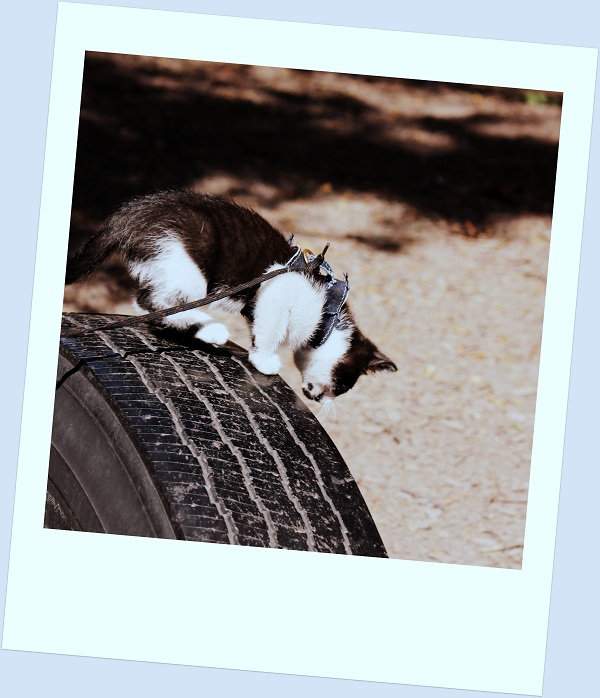
Kitten on Tire
Happy kitten on a leash at the playground


An outdoor enclosure is a fantastic option if you don't want your busy schedule interrupted by cat walking breaks.  Outdoor enclosures don't usually cost too much, and can be as simple or as fancy as you would like.  There are many ideas for cat runs, pens, and even cat proof fencing that you can buy if you want a little bit more ease.


Ten Tips for a Healthy Older Cat


Wessie
Wessie is only two

As your cat ages, you're going to have to care for them slightly differently then you would a young cat.  Your cat will be slowing down a little, and without proper care, may develop health problems.  Here are 10 tips for having a healthy older cat.

Ten Tips For a Healthier Cat:
  1. Loss of teeth- It is harder for the cat to chew, and it's possible for mouth bacteria to make its way into the cat's blood stream.  It's best if you made sure that your cat's dental health was good all of its life to prevent loss of teeth in the first place, but in the meantime, you can make eating easier for your cat by feeding it wet food, or dry food with a little water added in.  You can also try out using crunchy dental health treats, or investing in cat toothpaste and a cat toothbrush.  Try switching to a "complete" cat food, or if possible, feed them a food made especially for senior cats for a healthier diet.

  2. Less Exercise- The cat will become less agile.  You can keep your cat in shape by playing with them daily, or at least once a week.

  3. Stiff joints- Stiff joints will result in aching, and/or arthritis.  If your cat is licking its joints excessively, it may be a sign that your cat has stiff joints.  Your cat will be less likely to develop stiff joints if you play with your cat often.

  4. Skin disease- When your cat has a skin disease it may be in pain, and have an awful itch.  There are many different types of skin diseases.  Some are caused by allergies, others are caused by bug bites or worms.  There are quite a few different treatments for skin diseases, depending on what the cause is.

  5. More time sleeping- As your cat ages it will need more sleep, so give them a warm and comfortable place to nap.  Unfortunately, your cat will get less exercise, and will be prone to obesity.  Remember to have playtime with your cats, and they will get in some exercise.  You and your cat will also bond more if you play together.

  6. Less acute hearing- The cat might not hear you calling, and may be easily frightened or surprised.  This may lead to a flighty cat, who is afraid of people.  Try not to sneak up behind your cat, and stay in a range that it won't surprise them if they see you.

  7. Deteriorating eyesight- Your cat may develop cataracts, and may not notice their surroundings as much.  Make sure that you don't appear close up out the corner of their eye, and surprise them.

  8. Thinner coat and loss of conditioning- A thinner coat will leave the cat less protected from cold, and other animals.  Loss of conditioning may cause dry skin, which can lead to skin disease.  This can be prevented by giving your cat a supplement in his/her food such as fish oil.  Be sure that the food you are feeding them is nutritionally complete and has enough omega-3 fatty acids.  You may notice that your cat is starting to look scruffy.  As cats age, they don't groom as much, so you may consider purchasing a cat brush so you can help out and keep your cat well groomed.  You'll also find less cat hair around the house if you keep them groomed!

  9. Poorer absorption and digestion- This causes a sensitive stomach, allergies, stiff joints, lethargy, slow healing, bloating, poor coat or skin, loose stool, and excessive shedding.  It sounds awful, but can be prevented easily.  Some advise feeding your cat fresh, high quality meat, fowl, and fish, along with the use of probiotics, digestive enzymes, lipids, and minerals.  You can also help out your cat's digestive system by adding high fiber foods to their diet.  A little bit of pumpkin should work well.

  10. Obesity- Obesity can predispose cats to diabetes, Hepatic Lipidosis, and arthritis.  Once again, playing with your cat as exercise should help with obesity.  You may also want to put your cat on a diet to help it lose some weight.
Overall, give your cat a lot of love, and keep him/her comfortable in their older years.  Your cat will live longer, and stay healthy through their old age.