Showing posts with label cat behaviors. Show all posts

Diatomaceous Earth as a Natural Dewormer for Cats


Yikes!

Does your cat have worms?

Intestinal worms can infect just about any cat, but cats who live outdoors and hunt wild game are particularly susceptible to a worm infestation. Intestinal parasites may cause no symptoms in your cat, but some cats will present such unpleasant symptoms as weight loss, vomiting, and diarrhea. A natural and unpreventable problem, intestinal parasite infestation in cats has an equally natural solution - one that involves no chemicals or medicine and doesn’t demand a trip to the veterinarian.

Food-grade diatomaceous earth is a 100% natural, organic solution for internal pest infestation in cats.

What is diatomaceous earth and how does it work?

Diatomaceous earth is completely natural. It is formed from the remains of dead diatoms - these are microscopic single-celled algae. Once fossilized, all that remains of these tiny plants is their silica shells - which are easily crumbled into a very fine, slightly abrasive powder. The resulting powder is diatomaceous earth.

Diatomaceous earth attacks worms in a completely mechanical, non-chemical way. The fine powder, when greatly magnified, resembles shards of glass in structure, which is the secret to its strength. While food-grade diatomaceous earth is completely safe for ingestion by fish, rodents, cats, dogs, larger animals, and humans, it is lethal to most insects. Diatomaceous earth particles penetrate the outer shell of an insect’s body like a tiny shard of glass. This damage to their protective outer layer will either dehydrate or cut up the bug, leading to its death.

Taken internally, diatomaceous earth is effective for killing intestinal parasites like roundworms, whipworms, pinworms, tapeworms, and hookworms.

How can I use diatomaceous earth as a natural dewormer for my cat?

Diatomaceous earth is easy to administer. Mix the fine powder into your cat’s food. It’s relatively tasteless and is easy to incorporate into any type of cat food. Our cats eat diatomaceous earth daily as a supplement mixed into their wet food, and there’s never been a complaint!

We recommend about half of a teaspoon for smaller cats and kittens, and a teaspoon per day for larger adult cats - those weighing over about six pounds.

Continue to feed your cat diatomaceous earth daily for at least a month. Adult worms should be eliminated in within a week, while it will take longer to kill hatching eggs.

What are the risks?

Like any powder like flour or cornstarch, it’s best to avoid inhaling large amounts of diatomaceous earth. If you have concerns about breathing in the dust or suffer from respiratory issues, make sure you handle diatomaceous earth packages gently and work with it in a ventilated area.

It is critical that you use only food-grade diatomaceous earth. Non-food-grade, or industrial, DE has a higher crystalline silica concentration, making it too abrasive to take internally. This type of diatomaceous earth is used for pool and fish tank filtration or to make dynamite. It is not safe for animals to ingest. Using the wrong kind of diatomaceous earth can be very damaging to your cat’s health, so make sure that you use only food-grade diatomaceous earth.

Ready to get rid of your cat's worms? Buy food-grade diatomaceous earth for your cat here:

Why Does My Cat Lick Me?


Why Does My Cat Lick Me? 

In the most simple of terms, your favorite feline is showing you affection and petting you much the same way you pet him, but let's explore this in more detail.


Cat Licking Paw


Kittens are totally dependent on their mothers after they are born and one of the first things your kitty remembers is being licked and groomed by her mama. Immediately after delivery, felines lick their newborn kittens with their sandpaper-like tongues to stimulate breathing and to remove the birth sac and any fluids from their kitten's fur. This cleaning ritual feels really nice and includes a good over-all cleansing from the tip of their tiny pink nose to the end of their cute little tail. It's bonding for mama cat and her kittens, the same as cuddling and gentle stroking is for any human mother and newborn.

It is thought that kittens that have been weaned too early, or that have been prematurely removed from their mothers, sometimes lick more as adult cats than those that weren't. The act of licking their people companions is satisfying and recreates the pleasurable experience of being nurtured by mom. If you have a cat that loves to lick your face, hands, or arms, it is a compliment. She is demonstrating the comforting closeness that was experienced at birth.

__________________________________

His Licking Hurts! Why Is His Tongue So Rough?

Now that we know the basis for cat licking is comfort and affection, what's up with those rough kitty-cat tongues?  Being licked on the hand by your cat is an experience to be had, a skin peel of sorts where you feel like you've been exfoliated with coarse grit sandpaper. 

We all know that cats are clean creatures. They constantly groom behind their ears, in between their toes, and all over their fur bodies. They remove lots of dirt and grime with special tongues that mother nature has so aptly provided them. Cats tongues are covered in hook-like protuberances named papilla. A good way to understand these papilla is to visualize them as the hook in what we know as hook and loop closures. Papilla are made of keratin, the tough stuff fingernails are made of. These protruding papilla face backwards on your cat's tongue making his tongue comb-like, and durable enough for thorough cleanings, including the ability to remove shedding hair.

Ouch! No wonder his tongue feels so rough on my skin!


Rough Cat Tongue - Papilla
This image was originally posted to Flickr by Jennifer Leigh at http://flickr.com/photos/45206157@N00/388846359. It was reviewed on  by the FlickreviewR robot and was confirmed to be licensed under the terms of the cc-by-2.0.


_________________________________


Why Does My Cat Lick Herself? 

Aside from grooming, cats that are under stress may lick themselves for comfort. If you find your cat is incessantly licking herself, she may be anxious. Give her more attention and remove her from the situation that is making her nervous. Sooth and calm her with gentle petting.

If you notice a change in your cat's over-all licking behavior, it may be something more than grooming. Older felines and cats that are licking frequently could be ill. Insect bites, skin irritations, fleas, and mouth conditions could be the culprit.

_____________________________

Your Cat's Licking You Is Normal 

Cats are wonderful creatures and their licking is all part of what makes them fascinating, but don't respond harshly if you don't like your kitty's affectionate scratchy licks. Discourage and distract their behavior with toys or catnip. Spritz some lemon juice on your skin; cats don't like it and will shy away. But be careful. You may get what you wish for, and find yourself missing your favorite feline's lovable licks. 


How to Leash Train Your Cat


Little girl walking a cat on leash.
Proof that people have been leash walking cats for a long time.
The article on training your cat to walk on a leash is finally here!  I didn't mean to be 20 days in between articles, but I was busy with a move and couldn't find time to sit down and write.  Now that I'm a little settled in, it's time to get back to you.

Leash walking cats is wonderful for people who don't want their cat to be exposed to the many dangers of the outdoors, but would still like their cat to get some fresh air.  Cat walking is not a new thing, though it has become more popular in recent years.  

The equipment is quite affordable.  A lot of patience will probably be the biggest investment that you'll be making when leash walking your cat.  Harnesses usually cost in the $15-$40 range, and a leash will only cost you about $3 depending on what you get.

Cats are notorious for escaping tight situations, which is good when they are in danger, but not so good when you're trying to take them on a walk.  That is why most people choose harnesses over collars when walking their cats.  Cat heads are shaped so that they cat easily slip out of a collar, while harnesses make it a bit more difficult.  If you truly want a safe and secure harness, I'd recommend a vest type harness.  

Find my harnesses at http://petoodles.net/ .


http://petoodles.net/store/

Once you have purchased a harness and leash, it is time to start your training routine.  Leave the harness near your cat's food dish, and after a few days, start putting it on the cat while he is eating.  Don't not leave your cat in the harness unsupervised.  You wouldn't want him to get tangled up on something.  

Follow the same steps with the leash.  Let your cat drag it around the house a little while before you hold the leash.  Don't pull on the leash, but give gentle tugs once in a while to let your cat know that you are on the other side of the leash.

You want your cat to associate the leash and harness with good things, so make sure that your cat is always doing something he enjoys when he is in it.  After the cat is used to the harness and leash, take him outside, increasing the time you are out each day.   Feed your cat his favorite treats when he does what you want.

Don't try to pull your cat to you if you are trying to go somewhere.  Instead, call your cat to you, and hopefully he'll follow.  Train your cat to come when called before taking him out.

You can expand your walks over time.  Try to keep to a certain walking route, as cats usually don't like change.  

Hope this helped!  


How Can I Safely Let My Cat Outside In An Urban Environment?

If you just adopted a cat (and you live in the city already), or recently made the move to an urban setting, you may be wondering how you can have peace of mind and still let your cat enjoy the outdoors.

You love your cat, and you know all too well how many dangers are out there in the city.  Cars, cruel people, diseased cats, dogs... etc.  You look sadly at your cat watching birds from the window, knowing that he'll never be able to feel the grass on his paws.

It's time to make a decision.  Will you put your cat out the door and wait for something terrible to happen, or keep your cat inside for his/her whole life?

This decision does not have to be difficult!  Your cat can have the best of both worlds, with only a little effort from you.

It's time to invest in a cat harness and leash.  Leash walking is a great idea if you live in an apartment or other place where you can't build an enclosure.  It's also the more affordable option!

If you thought leash walking was just for dogs, you're quite wrong.  With a little bit of training, not only will your cat be getting some fresh air, but you will be getting out too.  It won't be like walking a dog (cats are bit more stubborn!) but it will still be a great bonding experience and your cat will probably love it in no time!  I'll write an article in the future just on the topic of walking your cat.

(Considering a cat walking harness for your cat? Check out the selections at Petoodles!)


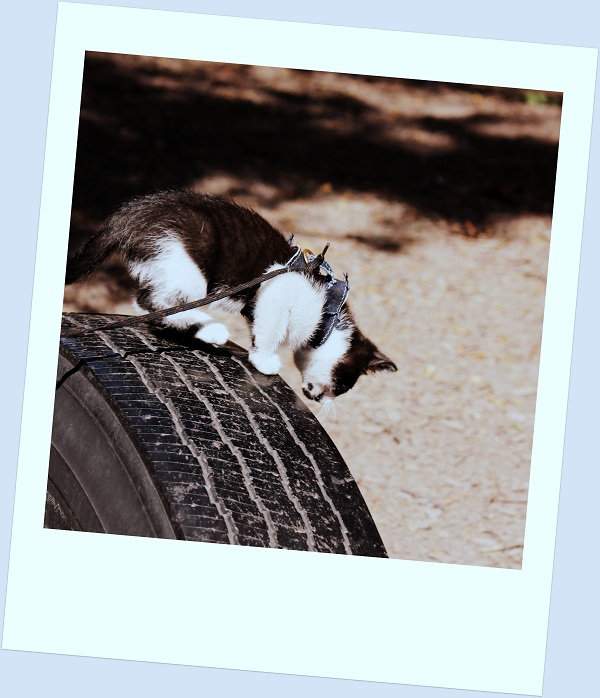
Kitten on Tire
Happy kitten on a leash at the playground


An outdoor enclosure is a fantastic option if you don't want your busy schedule interrupted by cat walking breaks.  Outdoor enclosures don't usually cost too much, and can be as simple or as fancy as you would like.  There are many ideas for cat runs, pens, and even cat proof fencing that you can buy if you want a little bit more ease.


Ten Tips for a Healthy Older Cat


Wessie
Wessie is only two

As your cat ages, you're going to have to care for them slightly differently then you would a young cat.  Your cat will be slowing down a little, and without proper care, may develop health problems.  Here are 10 tips for having a healthy older cat.

Ten Tips For a Healthier Cat:
  1. Loss of teeth- It is harder for the cat to chew, and it's possible for mouth bacteria to make its way into the cat's blood stream.  It's best if you made sure that your cat's dental health was good all of its life to prevent loss of teeth in the first place, but in the meantime, you can make eating easier for your cat by feeding it wet food, or dry food with a little water added in.  You can also try out using crunchy dental health treats, or investing in cat toothpaste and a cat toothbrush.  Try switching to a "complete" cat food, or if possible, feed them a food made especially for senior cats for a healthier diet.

  2. Less Exercise- The cat will become less agile.  You can keep your cat in shape by playing with them daily, or at least once a week.

  3. Stiff joints- Stiff joints will result in aching, and/or arthritis.  If your cat is licking its joints excessively, it may be a sign that your cat has stiff joints.  Your cat will be less likely to develop stiff joints if you play with your cat often.

  4. Skin disease- When your cat has a skin disease it may be in pain, and have an awful itch.  There are many different types of skin diseases.  Some are caused by allergies, others are caused by bug bites or worms.  There are quite a few different treatments for skin diseases, depending on what the cause is.

  5. More time sleeping- As your cat ages it will need more sleep, so give them a warm and comfortable place to nap.  Unfortunately, your cat will get less exercise, and will be prone to obesity.  Remember to have playtime with your cats, and they will get in some exercise.  You and your cat will also bond more if you play together.

  6. Less acute hearing- The cat might not hear you calling, and may be easily frightened or surprised.  This may lead to a flighty cat, who is afraid of people.  Try not to sneak up behind your cat, and stay in a range that it won't surprise them if they see you.

  7. Deteriorating eyesight- Your cat may develop cataracts, and may not notice their surroundings as much.  Make sure that you don't appear close up out the corner of their eye, and surprise them.

  8. Thinner coat and loss of conditioning- A thinner coat will leave the cat less protected from cold, and other animals.  Loss of conditioning may cause dry skin, which can lead to skin disease.  This can be prevented by giving your cat a supplement in his/her food such as fish oil.  Be sure that the food you are feeding them is nutritionally complete and has enough omega-3 fatty acids.  You may notice that your cat is starting to look scruffy.  As cats age, they don't groom as much, so you may consider purchasing a cat brush so you can help out and keep your cat well groomed.  You'll also find less cat hair around the house if you keep them groomed!

  9. Poorer absorption and digestion- This causes a sensitive stomach, allergies, stiff joints, lethargy, slow healing, bloating, poor coat or skin, loose stool, and excessive shedding.  It sounds awful, but can be prevented easily.  Some advise feeding your cat fresh, high quality meat, fowl, and fish, along with the use of probiotics, digestive enzymes, lipids, and minerals.  You can also help out your cat's digestive system by adding high fiber foods to their diet.  A little bit of pumpkin should work well.

  10. Obesity- Obesity can predispose cats to diabetes, Hepatic Lipidosis, and arthritis.  Once again, playing with your cat as exercise should help with obesity.  You may also want to put your cat on a diet to help it lose some weight.
Overall, give your cat a lot of love, and keep him/her comfortable in their older years.  Your cat will live longer, and stay healthy through their old age.


Introducing Your Cat to the Outdoors

Are you considering introducing your indoor cat to the outdoors?  Find out how to make it easier on your cat in this article.

There are advantages and disadvantages to letting your cat outdoors.  Make sure to think about them all before making a final decision.

Orange tabby cat sniffing grass


Pros:
  • Your cat will go to the bathroom outside, so you don't have to scoop a litter box regularly.
  • Your cat will be able to enjoy the freedom of the outdoors.
  • They will be able to have the unique experiences that only the outdoors can offer.
  • Your cat will probably have a richer and more exciting life.
Cons:
  • Your cat may have a shorter life span, due to other animals, cars, and cruel people.
  • Your cat will probably roam around, and may be near you less.
  • Others may not like your cat in their yard.
  • Your cat may disappear.  If the cat went off on its own, it will probably return, but there is always a chance that the cat was stolen.
Your cat will probably kill some of the birds and rodents in your area.  This can be a pro if you have too many rodents, but may also be a con if you like the local wildlife.

If you want your cat to have the freedom of going outside, without the possibility of the cat escaping your yard, you may want to consider a Purrfect Cat Fence, which is a cat proof fence that can be installed into your yard.

If you live in an area with a lot of traffic, it will be more dangerous to let your cat outside than if you live in a more rural area.  Keep this in mind when you are considering letting your cat outside.

Once you're sure that you want to let your cat outdoors, here's how to make it easier on them.

Before you let your cat outdoors, consider teaching him/her to come when called.  Don't know how to train your cat?  Here's how.

First of all, give your cat a treat.  Get another treat, and show it to your cat.  Go to the other end of the room, get down, and call your cat by their name.  Your cat will probably come to get another treat.  If the cat comes, praise them, and give them the treat.  Go to another room in your house, and call your cat again.  The cat will probably start to come when you call, because they know that they will be rewarded.  Be sure to have a treat on hand every time you call your cat.  If you don't reward your cat each time, they may decide that there is no point in coming.

If you just got your cat, keep it indoors.  This will give it time to adjust to you, causing the cat to be less likely to run away.  Also keep kittens indoors, as they are more likely to run into the street than older cats.

Once your cat has lived with you for a few months, and you know that both you and the cat are ready for the transition, open your door to the outdoors.

At first the cat will probably be reluctant to go out, unless he/she was an outdoor cat at a previous home.  If your cat doesn't want to go, put some of the cat's favorite food outside, or call the cat with a treat.  Don't be too hard on the cat.  If it doesn't want to go out, don't force it to.  The cat may have bad memories of something associated with the outdoors.  Once the cat is outside, let him/her explore a little.  They may want to stay in the same spot, while they also might do the opposite, and run off.  To prevent your cat from running off, consider using a leash the first time you are letting your cat out.

In the beginning, keep your cat's outdoor sessions short.  You may also want to supervise your cats first outdoor sessions so that you know how the cat acts outside.  Increase the length of the sessions over time, and your cat will probably begin to love the world of the outdoors. At first it seemed that Wessie would never like the outdoors, but soon he almost never wanted to go inside!


Is It Time to Adopt a Cat?

Are you considering adopting a cat? Find out the responsibilities and proper care of your new feline friend.

Kitten with collar
Right after we adopted Wessie

Cats can be wonderful and loving creatures that offer a lot of love and companionship. Before you adopt a cat, you need to ask yourself a few questions. Why do you want a cat? Do you want the cat for companionship? Think about your home situation. Do you have enough room to care for a cat? Are you renting? If so, does your landlord allow you to have pets? How much time are you willing to devote to your pet? This quiz on Animal Planet may help you to find out what pet is right for you.


Once you've decided that you really want a cat, it's time to ask yourself if you will be letting the cat outside. Will the cat be an outside cat, indoor only, or an indoor/outdoor cat? Consider what will be best for the cat, and what you believe the cat would want the most.

You must also decide whether you want a cat or kitten. If you want to raise your cat, and have it grow up in your care, then you will want a kitten. They may need more training than adult cats. Kittens are more likely to be attached to you, as they will be growing up around you, and will know you all of their lives.  When you adopt a kitten instead of an adult cat, it may be less likely to run away if you are letting it outdoors, as it doesn't have past homes to go to.

Adult cats can make great pets as well. They are more likely to be docile, and not as playful as a kitten. Adult cats can also be very playful. Past experiences may have made them attached to someone or something, making adult cats more likely to run away than kittens.  Remember, as you are considering these two options, think about what will be best for you and your situation.

You've made your decision, and decided that it's time for you to get a cat. It is now time to prepare yourself and your home for your new kitty.

Cats are easy to care for. Their maintenance can cost from around 100-800 dollars a year. The yearly cost for Wessie is around 148 dollars. The way to keep costs down is to make your own cat toys, don't buy too many cat treats, and use old containers that you have around for cat food and water dishes. There are many ideas for keeping your cat care budget low.  Outdoor cats also cost less, as they don't use very much litter.

You are going to have to feed your cat daily.  It is best to give them measured food, as opposed to free feeding, to prevent your cat becoming overweight. You will also need  to scoop your cat's litter daily, and change it at least once a week. Make sure that your cat has a clean bowl of water available at all times. You should also play with your cat daily. This will prevent it from becoming overweight, and will keep it healthy.

You know how to care for your new cat, so now it is time to prepare your home. Make sure that there is a safe and preferably small room that you can keep your cat in as he adjusts to his new home. Scan the room with your eyes. Do you see anything potentially dangerous for a cat? Strings dangling? Small things that the cat could play with, and choke on? If you don't see any of these things, get down on your hands and knees, and look around. Pick up anything that you wouldn't want near your new cat. Look around your whole house, and make sure that it is cat proof.

When you know that is safe for your kitty, it is time to get your supplies. First of all, you may want a cat toy so that you can give your cat exercise and supply him with play. You can even make your own handmade cat toys! Here's a link to my "how to make cat toys" page, which features a couple of easy toys to make. How to Make Your Own Cat Toys

You will also want to purchase a cat carrier. I use a Petmate pet taxi for Wessie's transportation. You'll want the carrier early so that you can take your new pet home from the adoption facility.

When you are at the adoption facility, look around. What cat or kitten catches your eye? If none do, then maybe your purrfect cat isn't there. It's important that you aren't just choosing the cat for its looks. The cat should be what you want, and have a good purrsonality. You and the cat/kitten should get along right off.

Once you have chosen your cat, ask to see it out of the cage. This is important, because if you really want a lap cat, you may discover that the cat you chose hates to be touched. When I took Wessie out of the cage, I discovered that he didn't like to be held. This trait has stayed with him all his life, and it is only once in a while that he actually sits on my lap.

Once you've held the cat, you have to find out if it's healthy. Don't solely rely on a staff member, rely on your own good judgment.  Check in the cat's ears, eyes, and nose. If all of these places seem free of mucus, then the cat is probably healthy. Ask about the cats medical records. Make sure that it has had rabies vaccinations if you are planning on letting the cat outside. This is especially important if you live somewhere where there are a lot of rabies carrying animals, such as raccoons.

If you are fully satisfied with the cat, it is time to adopt. There are usually some papers that you will have to fill out. The adoption fees for cats vary, depending on where you are adopting your cat. Once you go through the adoption process, it is time to take the cat home with you.

Once you are in the room you previously prepared for your cat, open up the door of the carrier. Your cat may hide in it for awhile, but will probably slowly come out and explore the room. Remember, this is an extremely stressful experience for your new cat. Don't pressure the cat to explore its surroundings. It'll explore on its own. You can leave the cat alone as it adjusts to its new home. When we got Wessie, we let him out in the bathroom. He hid under the bathtub. To gain his trust, and to lure him out from under the tub, we held out a homemade fishing pole toy for him to play with. Slowly but surely, Wessie gained our trust. Your cat will too. Some cats are harder to earn their trust than others. It takes time and patience for a cat to adjust to your home.

Play with your cat everyday. This will exercise your cat, you will have fun, and your cat will trust you more. After one year of owning your cat, you may think that you know everything about him, but you learn new things about your pet almost everyday.

Have fun with your new friend, treasure your new pet, and take good care of him!


Feline UTI and Home Remedy


Cat Litter Box - Feline UTI

This information is not a replacement for veterinary care.  It is almost impossible to diagnose your cat at home.  Improper use of this information may actually worsen your cat's condition if you have incorrectly diagnosed.

Feline UTI. All pet owners worry when they see the signs of this fatal disease it their cat. But how do you know he really has it, and what do you do if he does? Read more, and find out.

Feline UTI (urinary tract infection) is a disease that many
cats have. It’s mostly found in neutered male cats. Since it is a fatal but highly treatable disease, you will want to know the signs so that you can treat it early. UTI shows up very quickly, one day your cat is fine, and the next he is blocked by crystals or bladder stones. Toxins will build up in the cat’s body, as the kidneys are no longer filtering bad things out of the cat’s system. If your cat isn't treated, it can die within 24 hours. Recognizing the signs and symptoms is easy. Some of the first symptoms are urinating outside of the litter box, straining to urinate, blood in the urine, excessive licking of the genitals, and crying in the litter box.

Some may just think that their cat has developed bad cat behaviors. This is because they may be urinating on the floor away from the litter box. The cause of this is that if the cat finds it painful to use the litter box, they may start to identify the box as the problem. In this case, they will avoid it, trying to escape the pain. If not quickly corrected, you may have a lot of trouble getting your cat to use his litter box again.

A cat’s bladder will usually feel like a slippery water balloon. However, when it has UTI, the bladder will more likely feel like a hard peach, as it is all full. Palpate your cat’s stomach, and see if it feels hard. Hopefully it will feel normal, and soft. Once in a while, the palpating actually releases the blockage.

UTI is usually treated by a vet. At the vet they will use a catheter to push the blockage out, or back into the bladder where it will dissolve. This is a painful operation for the cat. Because of the pain, anesthetic is given to the cat. Usually, the cat will be kept at the vets for a few days with a catheter attached to them to make sure that the cat doesn't have the blockage come back, or if you are on a budget, you can leave right after the operation is complete. These vet visits may cost up to around $4,000, so you might want to treat at home.

For this, I recommend apple cider vinegar. I used ACV along with Gimborn Uri Soothe for urinary tract health. After about five days of apple cider vinegar and Uri soothe treatment, Wessie is now urinating normally. It was low cost, around $10.08, while a visit to the vets can cost over a thousand dollars.

If you are trying to treat at home, here are some tips.
  • When your cat has UTI, regularly scoop his box so that you can see any new urine that he has left.
  • Make sure that the cat keeps hydrated, but that he doesn't have too much water, as he will then be in extreme discomfort if he is unable to release the pressure.
  • Feed your cat his normal amount of wet food with a capful of ACV mixed in. If your cat usually has dry, switch to wet.
  • You might want to find a urinary tract supplement like we did.

Here’s my story of Wessie’s UTI
I knew that Wessie had a problem when I saw him straining to urinate, and nothing came out. Immediately I thought of feline UTI, as Wessie is a neutered male.

I went to the Internet to find out what you can do for your cat when he has UTI. I searched for things that you can do to help a cat with UTI. Most resources advised going to the vet. Then, I came across a website that suggested feeding your cat apple cider vinegar. After reading the reviews on ACV (apple cider vinegar), I decided to try it to save my kitty’s life. Many people were satisfied with it, and very few said that it didn't work to help their cat.

I explored different websites to find additional advice, and decided to get Wessie some canned cat food. It turned out that cats that eat dry food are more likely to get UTI than wet food eaters, as they don’t get as much water.

We headed out to Petco to see if there was any kind of urinary health treatment for cats. We found Gimborn Uri Soothe, which is used for cat urinary tract support. Afterwards, we headed over to the grocery, and picked up our ACV and canned cat food. Later, we blended the recommended teaspoon of Uri soothe with Wessie’s new food, and put it out for him to eat. Over the day, we fed him food mixed with ACV, and found that Wessie was becoming slightly more successful with his urination. During the night, I left my bedroom door open so that Wessie had easy access to his litter box. Awakening in the night to check on him, I found out that he had used the litter box and made an almost normal sized urine cake. Then, as if to prove to me that he could go and actually make something, he proceeded to urinate in front of me, leaving about a golf ball sized puddle. That day he made more golf ball sized puddles, but occasionally was unable to urinate.

The next day, Wessie was making slightly smaller than normal puddles, and sometimes made a nice large normal sized one. After several days, Wessie is urinating normally, and has his regularly large puddles.


Cats May See Things We Cannot

Orange Tabby Cat on Blanket


Has your cat ever acted as if there is some invisible thing that scares him? This article is a pondering of what the cause of this is. My first experience with this behavior was when my cat was fairly young, at age one. He didn't want to go under our porch, where he normally loved to hang out. If we put him under it, he would dash away and act terrified. My first reaction was that a visitor cat had sprayed under there or something. A while later, when he was perfectly fine with going under the porch again, this idea was proved wrong when my cat was scared of his box, normally one of his favorite places to sleep. There were no other cats in the house.


Quite recently, my cat was sitting around in our mudroom, one of his favorite places to sit around. I was working and not paying attention to him, when it sounded as if he slipped on the rug, and he ran upstairs. Sure enough, the rug had been moved. I don't know why he slipped on the rug, as he wasn't playing. If playing, slipping would be normal, because he could have been running around and moved the rug. He kept returning to the mudroom and acted how he does when interacting with other felines. Suddenly, for no apparent reason, he dashed upstairs, as if something was chasing him. Out of the corner of my eye I saw a dark gray shadow going after him.

Immediately I thought of shadow people. You can't see them head on, just out of the corner of your eye and then they vanish. Upon looking in up, I discovered that many people see shadow animals. Do you think what I saw was a shadow cat?

Some may think that their cat interacts with spirits, perhaps earthbound cats, the ghost of the past. The house I live in is over one-hundred years old, do you think that perhaps it was the ghost of a past pet? Since animals can sense when disaster is about to strike, do you think that they can sense things beyond this world?

Earlier this month, before the "shadow cat" incident, a family member had mentioned that she had seen a glimpse of a "phantom" cat. She walked into the kitchen and glanced towards the doorway. There was a cat sitting in the doorway, while our cat was walking calmly past her. The cat in the doorway vanished. These kinds of things happen to people all the time. Do you think it's just our eyes playing tricks on us, or something truly supernatural?

If your cats acts as if there is something invisible that he sees, don't overreact. Don't think that you have to move out because there is a ghost infestation or something.

There are numerous reasons why a cat would appear to see something invisible. Some discover that when their cat appears to be playing with invisible things, it turns out that it was a speck of dust, or microscopic bug. Think about it. What do YOU think your cat sees?


_________________________

Here's an update that's more on the scientific side. Studies have shown that cats can see ultra-violet (UV) light. That means that that they can see in a range that is beyond what humans can see. This would be particularly helpful for cats and other prey animals when searching for food in the outdoors. 


More resources:

All About Cat Scratching

Ow! My cat just scratched my arm! What should I do? Don't panic.


Cat Claw


It's very typical cat behavior to scratch. It is usually a form of defense, but can be playful. When playing with you, cats tend to keep their claws hidden. They may accidently unsheathe their razor sharp claws and scratch you. Don't think that this means that your cat wants to hurt you. If you were just playing with him and got too close to the toy, he probably accidently swiped you. Ever so often your cat may scratch you on purpose. You may be petting him/her in a painful or sensitive area. If your

cat scratches you or gives any warning signs that he is annoyed, stop doing what you are doing. It is probably bothering him, and you don't want him to think you are trying to be mean. Tell him no, and reward him when he doesn't scratch you. Cats are smart and can usually be broken of bad behaviors.

Cat scratches can hurt. If a cat scratches you, wash the wound and use peroxide on it to prevent an infection. Most of us have been scratched by a cat some time in our life. Don't overreact if you get scratched, it's usually not a big deal. Once in a while scratches inflict cat scratch disease. Cat scratch disease (sometimes called cat scratch fever), is a disease that can be given to a human by being scratched by a cat. Bartonella henselae is the bacterium that causes the disease and is found through out the world. It causes swelling of the lymph nodes in humans. The disease is usually transmitted through scratches, licks, and bites. The cats are infected by fleas, who bite them and pass on the disease. The bacteria live in the infected cat’s saliva, but don’t make the cats sick. Experts think that almost 50% of cats have been infected at some time in their lives. Kittens younger than a year old are more likely to be infected. Don’t worry, cat scratch disease symptoms are usually mild, them being mainly swollen lymph nodes. For more info on cat scratch disease click the link to the Wikipedia article.
http://en.wikipedia.org/wiki/Cat_scratch_disease

If your cat is scratching you or your furniture, don't automatically turn to declawing. Claws are not only needed for protection, but are also needed for balance, climbing, and exercise. Declawing is a painful operation that actually cuts the cats toe joint. There are also many side-effects, such as back pain, and litter box problems. There is another option.
Soft Paws claw caps are a more humane solution to your cat's scratching problems.
Remember, have fun with your cat, but play safe!


Cat Biting-Is This Normal?

Is your cat biting your feet in the morning? Do you get up and he nips your ankles? Don’t overreact. There are many reasons that your cat may be biting you.

A lot of the time, your cat just wants to be fed. “But he has food in his dish!” This could mean that he just wants attention. My cat, Wessie, loves for me to sit in the room while he eats. You might want to spend a little bit more time with your feline friend. Cat behaviors vary greatly in different cats, just like you and I have different personalities.
Cat Biting

It is normal for a kitten to bite, while in older cats it is a little more irregular. Sometimes your cat may not like you petting him. In this case your cat will usually give a few warning signs before biting. These can include tail thumping, hissing, growling, shifting position, ear flicking, cessation of purring and skin rippling. Every cat is different. By learning to understand your cat’s warnings you will lessen the chance of getting hurt.

Biting can be simply playful as well. This behavior will begin when the cat is a kitten. Do not go along with this vicious play, or your kitten will begin to consider you a plaything. Kitten nibbles can be cute. But when kitty grows up so will its teeth, and those once cute bites may become flesh breaking wounds. Some cats may like to ambush their owners by leaping out and biting you. They may come from behind corners, furniture, doorways, and may surprise or injure you. Ambush biting is a sign that you raised your cat to think you are a toy. When your cat does this don’t pull away or act afraid. This resembles prey and will only make your cat want to bite harder. Gently push him away (be careful), and say “NO” in a authoritative tone.

Sometimes the cat may become aggressive when a new baby, pet, or even new furniture is introduced to the home. In this case, let your cat be alone for a while, and he/she will probably adjust to the new arrangement.

Once in a while biting is a sign of sickness. Your cat may hide under the bed or behind furniture, and when you approach he/she may bite you. Your cat may have gotten in a cat fight and been hurt, or there may be a more serious injury or illness. If your normally friendly and affectionate cat suddenly gets extremely vicious, contact a vet, as this can be a sign of rabies. Sadly, rabies usually ends fatally. If you were bitten by your cat that you suspect has rabies, you should visit a doctor, and get a vaccination.

Cat biting can be signs of play, annoyance, illness, and even trying to tell you something. Don’t always get all hyped up just because your cat nibbles you in the morning. But remember, listen to your cat if he is trying to tell you that he is hurt.