Feline UTI and Home Remedy


Cat Litter Box - Feline UTI

This information is not a replacement for veterinary care.  It is almost impossible to diagnose your cat at home.  Improper use of this information may actually worsen your cat's condition if you have incorrectly diagnosed.

Feline UTI. All pet owners worry when they see the signs of this fatal disease it their cat. But how do you know he really has it, and what do you do if he does? Read more, and find out.

Feline UTI (urinary tract infection) is a disease that many
cats have. It’s mostly found in neutered male cats. Since it is a fatal but highly treatable disease, you will want to know the signs so that you can treat it early. UTI shows up very quickly, one day your cat is fine, and the next he is blocked by crystals or bladder stones. Toxins will build up in the cat’s body, as the kidneys are no longer filtering bad things out of the cat’s system. If your cat isn't treated, it can die within 24 hours. Recognizing the signs and symptoms is easy. Some of the first symptoms are urinating outside of the litter box, straining to urinate, blood in the urine, excessive licking of the genitals, and crying in the litter box.

Some may just think that their cat has developed bad cat behaviors. This is because they may be urinating on the floor away from the litter box. The cause of this is that if the cat finds it painful to use the litter box, they may start to identify the box as the problem. In this case, they will avoid it, trying to escape the pain. If not quickly corrected, you may have a lot of trouble getting your cat to use his litter box again.

A cat’s bladder will usually feel like a slippery water balloon. However, when it has UTI, the bladder will more likely feel like a hard peach, as it is all full. Palpate your cat’s stomach, and see if it feels hard. Hopefully it will feel normal, and soft. Once in a while, the palpating actually releases the blockage.

UTI is usually treated by a vet. At the vet they will use a catheter to push the blockage out, or back into the bladder where it will dissolve. This is a painful operation for the cat. Because of the pain, anesthetic is given to the cat. Usually, the cat will be kept at the vets for a few days with a catheter attached to them to make sure that the cat doesn't have the blockage come back, or if you are on a budget, you can leave right after the operation is complete. These vet visits may cost up to around $4,000, so you might want to treat at home.

For this, I recommend apple cider vinegar. I used ACV along with Gimborn Uri Soothe for urinary tract health. After about five days of apple cider vinegar and Uri soothe treatment, Wessie is now urinating normally. It was low cost, around $10.08, while a visit to the vets can cost over a thousand dollars.

If you are trying to treat at home, here are some tips.
  • When your cat has UTI, regularly scoop his box so that you can see any new urine that he has left.
  • Make sure that the cat keeps hydrated, but that he doesn't have too much water, as he will then be in extreme discomfort if he is unable to release the pressure.
  • Feed your cat his normal amount of wet food with a capful of ACV mixed in. If your cat usually has dry, switch to wet.
  • You might want to find a urinary tract supplement like we did.

Here’s my story of Wessie’s UTI
I knew that Wessie had a problem when I saw him straining to urinate, and nothing came out. Immediately I thought of feline UTI, as Wessie is a neutered male.

I went to the Internet to find out what you can do for your cat when he has UTI. I searched for things that you can do to help a cat with UTI. Most resources advised going to the vet. Then, I came across a website that suggested feeding your cat apple cider vinegar. After reading the reviews on ACV (apple cider vinegar), I decided to try it to save my kitty’s life. Many people were satisfied with it, and very few said that it didn't work to help their cat.

I explored different websites to find additional advice, and decided to get Wessie some canned cat food. It turned out that cats that eat dry food are more likely to get UTI than wet food eaters, as they don’t get as much water.

We headed out to Petco to see if there was any kind of urinary health treatment for cats. We found Gimborn Uri Soothe, which is used for cat urinary tract support. Afterwards, we headed over to the grocery, and picked up our ACV and canned cat food. Later, we blended the recommended teaspoon of Uri soothe with Wessie’s new food, and put it out for him to eat. Over the day, we fed him food mixed with ACV, and found that Wessie was becoming slightly more successful with his urination. During the night, I left my bedroom door open so that Wessie had easy access to his litter box. Awakening in the night to check on him, I found out that he had used the litter box and made an almost normal sized urine cake. Then, as if to prove to me that he could go and actually make something, he proceeded to urinate in front of me, leaving about a golf ball sized puddle. That day he made more golf ball sized puddles, but occasionally was unable to urinate.

The next day, Wessie was making slightly smaller than normal puddles, and sometimes made a nice large normal sized one. After several days, Wessie is urinating normally, and has his regularly large puddles.


Cats May See Things We Cannot

Orange Tabby Cat on Blanket


Has your cat ever acted as if there is some invisible thing that scares him? This article is a pondering of what the cause of this is. My first experience with this behavior was when my cat was fairly young, at age one. He didn't want to go under our porch, where he normally loved to hang out. If we put him under it, he would dash away and act terrified. My first reaction was that a visitor cat had sprayed under there or something. A while later, when he was perfectly fine with going under the porch again, this idea was proved wrong when my cat was scared of his box, normally one of his favorite places to sleep. There were no other cats in the house.


Quite recently, my cat was sitting around in our mudroom, one of his favorite places to sit around. I was working and not paying attention to him, when it sounded as if he slipped on the rug, and he ran upstairs. Sure enough, the rug had been moved. I don't know why he slipped on the rug, as he wasn't playing. If playing, slipping would be normal, because he could have been running around and moved the rug. He kept returning to the mudroom and acted how he does when interacting with other felines. Suddenly, for no apparent reason, he dashed upstairs, as if something was chasing him. Out of the corner of my eye I saw a dark gray shadow going after him.

Immediately I thought of shadow people. You can't see them head on, just out of the corner of your eye and then they vanish. Upon looking in up, I discovered that many people see shadow animals. Do you think what I saw was a shadow cat?

Some may think that their cat interacts with spirits, perhaps earthbound cats, the ghost of the past. The house I live in is over one-hundred years old, do you think that perhaps it was the ghost of a past pet? Since animals can sense when disaster is about to strike, do you think that they can sense things beyond this world?

Earlier this month, before the "shadow cat" incident, a family member had mentioned that she had seen a glimpse of a "phantom" cat. She walked into the kitchen and glanced towards the doorway. There was a cat sitting in the doorway, while our cat was walking calmly past her. The cat in the doorway vanished. These kinds of things happen to people all the time. Do you think it's just our eyes playing tricks on us, or something truly supernatural?

If your cats acts as if there is something invisible that he sees, don't overreact. Don't think that you have to move out because there is a ghost infestation or something.

There are numerous reasons why a cat would appear to see something invisible. Some discover that when their cat appears to be playing with invisible things, it turns out that it was a speck of dust, or microscopic bug. Think about it. What do YOU think your cat sees?


_________________________

Here's an update that's more on the scientific side. Studies have shown that cats can see ultra-violet (UV) light. That means that that they can see in a range that is beyond what humans can see. This would be particularly helpful for cats and other prey animals when searching for food in the outdoors. 


More resources:

All About Cat Scratching

Ow! My cat just scratched my arm! What should I do? Don't panic.


Cat Claw


It's very typical cat behavior to scratch. It is usually a form of defense, but can be playful. When playing with you, cats tend to keep their claws hidden. They may accidently unsheathe their razor sharp claws and scratch you. Don't think that this means that your cat wants to hurt you. If you were just playing with him and got too close to the toy, he probably accidently swiped you. Ever so often your cat may scratch you on purpose. You may be petting him/her in a painful or sensitive area. If your

cat scratches you or gives any warning signs that he is annoyed, stop doing what you are doing. It is probably bothering him, and you don't want him to think you are trying to be mean. Tell him no, and reward him when he doesn't scratch you. Cats are smart and can usually be broken of bad behaviors.

Cat scratches can hurt. If a cat scratches you, wash the wound and use peroxide on it to prevent an infection. Most of us have been scratched by a cat some time in our life. Don't overreact if you get scratched, it's usually not a big deal. Once in a while scratches inflict cat scratch disease. Cat scratch disease (sometimes called cat scratch fever), is a disease that can be given to a human by being scratched by a cat. Bartonella henselae is the bacterium that causes the disease and is found through out the world. It causes swelling of the lymph nodes in humans. The disease is usually transmitted through scratches, licks, and bites. The cats are infected by fleas, who bite them and pass on the disease. The bacteria live in the infected cat’s saliva, but don’t make the cats sick. Experts think that almost 50% of cats have been infected at some time in their lives. Kittens younger than a year old are more likely to be infected. Don’t worry, cat scratch disease symptoms are usually mild, them being mainly swollen lymph nodes. For more info on cat scratch disease click the link to the Wikipedia article.
http://en.wikipedia.org/wiki/Cat_scratch_disease

If your cat is scratching you or your furniture, don't automatically turn to declawing. Claws are not only needed for protection, but are also needed for balance, climbing, and exercise. Declawing is a painful operation that actually cuts the cats toe joint. There are also many side-effects, such as back pain, and litter box problems. There is another option.
Soft Paws claw caps are a more humane solution to your cat's scratching problems.
Remember, have fun with your cat, but play safe!


Cat Biting-Is This Normal?

Is your cat biting your feet in the morning? Do you get up and he nips your ankles? Don’t overreact. There are many reasons that your cat may be biting you.

A lot of the time, your cat just wants to be fed. “But he has food in his dish!” This could mean that he just wants attention. My cat, Wessie, loves for me to sit in the room while he eats. You might want to spend a little bit more time with your feline friend. Cat behaviors vary greatly in different cats, just like you and I have different personalities.
Cat Biting

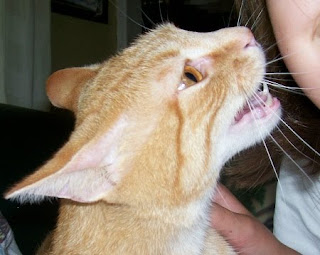
It is normal for a kitten to bite, while in older cats it is a little more irregular. Sometimes your cat may not like you petting him. In this case your cat will usually give a few warning signs before biting. These can include tail thumping, hissing, growling, shifting position, ear flicking, cessation of purring and skin rippling. Every cat is different. By learning to understand your cat’s warnings you will lessen the chance of getting hurt.

Biting can be simply playful as well. This behavior will begin when the cat is a kitten. Do not go along with this vicious play, or your kitten will begin to consider you a plaything. Kitten nibbles can be cute. But when kitty grows up so will its teeth, and those once cute bites may become flesh breaking wounds. Some cats may like to ambush their owners by leaping out and biting you. They may come from behind corners, furniture, doorways, and may surprise or injure you. Ambush biting is a sign that you raised your cat to think you are a toy. When your cat does this don’t pull away or act afraid. This resembles prey and will only make your cat want to bite harder. Gently push him away (be careful), and say “NO” in a authoritative tone.

Sometimes the cat may become aggressive when a new baby, pet, or even new furniture is introduced to the home. In this case, let your cat be alone for a while, and he/she will probably adjust to the new arrangement.

Once in a while biting is a sign of sickness. Your cat may hide under the bed or behind furniture, and when you approach he/she may bite you. Your cat may have gotten in a cat fight and been hurt, or there may be a more serious injury or illness. If your normally friendly and affectionate cat suddenly gets extremely vicious, contact a vet, as this can be a sign of rabies. Sadly, rabies usually ends fatally. If you were bitten by your cat that you suspect has rabies, you should visit a doctor, and get a vaccination.

Cat biting can be signs of play, annoyance, illness, and even trying to tell you something. Don’t always get all hyped up just because your cat nibbles you in the morning. But remember, listen to your cat if he is trying to tell you that he is hurt.